
Loose or Corroded Rails Restored to Safe Condition
Handrail repair in Fort Myers for loose fasteners, corroded sections, and railing systems that no longer meet code
A handrail that moves under load has already failed the standard it was built to meet, regardless of how structurally intact it looks from a distance. A Tip Top Rescreen repairs loose, damaged, and rusted handrails on decks, stairs, and lanais for residential and commercial properties in Fort Myers, addressing the specific failure points that cause rails to become unsafe and non-compliant over time. Exterior aluminum and wood railing systems both develop fastener failures and corrosion at connection points—the type of deterioration determines what repair approach actually restores load integrity rather than just concealing the problem.
Every repair starts with a full inspection of the handrail system to identify rust, loose fasteners, cracked wood, bent rails, and any section where structural members have corroded past the point of tightening. Fasteners that are loose but intact are torqued to spec; fasteners that have corroded or stripped are replaced with appropriate hardware. Corroded structural sections are cut out and replaced rather than patched, because a corroded rail section that has lost wall thickness will not hold load even after it is cleaned and treated. Load integrity and code compliance are verified before the job is finished.
To get a repair assessment for a railing system showing movement, corrosion, or visible damage, schedule an inspection with A Tip Top Rescreen.
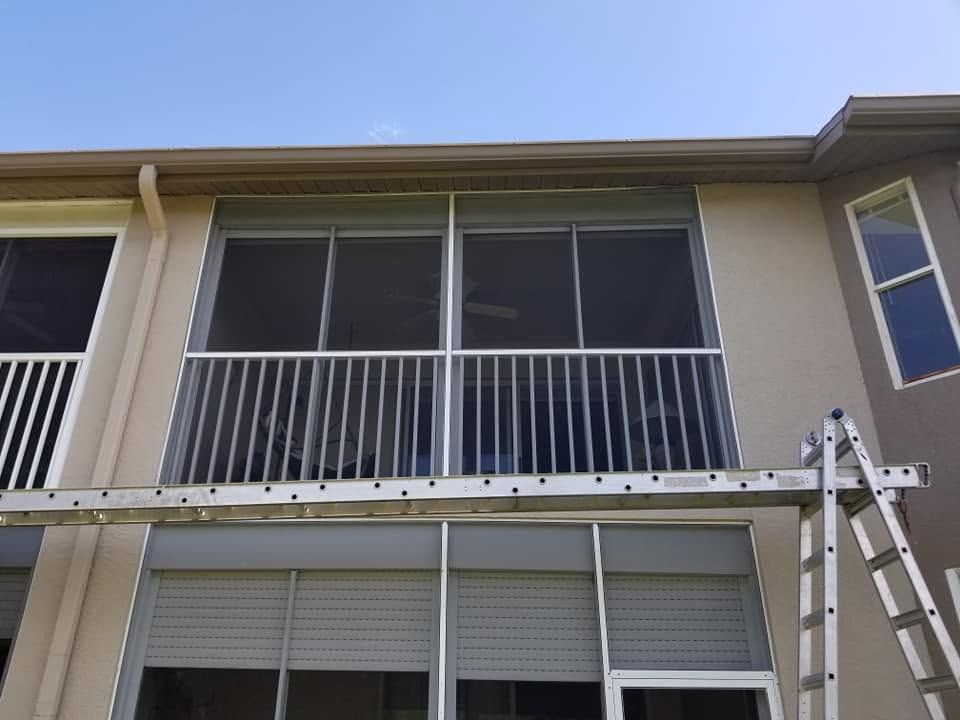
How Handrail Repair Addresses Both Safety and Compliance
The most common failure pattern in exterior handrails is corrosion at the post base—where the post meets the deck surface or mounting plate—because that connection point holds standing water and collects debris that accelerates metal breakdown. On aluminum systems, this shows up as pitting and white oxidation at the fastener holes; on steel or iron systems, it progresses to rust that expands and cracks the surrounding material. A Tip Top Rescreen evaluates each post base individually during inspection because corrosion severity varies post by post, and a repair that replaces only the most visibly damaged sections without checking the others will return for the same problem within a short cycle.
After repairs are complete, the handrail system will hold lateral load at each post without movement, balusters will be secure at both ends, and the top rail will be continuous and firm across its full run. On commercial properties or residential structures where the deterioration had been noted in a prior inspection report, the completed repair also closes out the outstanding compliance issue against that railing system.
Some repairs also require confirming that the existing rail height and baluster spacing still meet current code—particularly on older Fort Myers residential construction where railings were installed under previous code editions with different spacing requirements. If the railing geometry no longer meets current standards, that is identified during the inspection phase so the scope of repair can include any necessary corrections before the job closes.
Questions About How Handrail Repair Is Performed
These questions address how repair decisions are made, what gets replaced versus tightened, and what property owners in Fort Myers will see once the work is finished.
How do you determine which fasteners need replacement versus retightening?
Fasteners that are corroded, stripped, or have lost thread engagement are replaced because retightening a compromised fastener does not restore its holding strength—the thread interface must be sound for the connection to meet load requirements.
What happens when a corroded section of rail cannot be repaired in place?
Corroded sections that have lost structural wall thickness are cut out and replaced with new material sized and finished to match the existing railing run—patching over a corroded section without replacement leaves a weak point that will fail under load even if it appears intact.
How is load integrity verified after repairs are completed?
Each repaired post connection is checked for lateral movement by applying a horizontal load at the top rail—any connection that still shows movement after fasteners are set indicates a deeper substrate issue that requires additional repair before the job is finished.
Why do older Fort Myers residential railings sometimes fail inspection after repair?
Handrails installed under older Florida Building Code editions may have baluster spacing or rail heights that no longer meet current requirements; a repair that restores structural integrity but does not correct non-compliant geometry will still fail a code inspection, so those dimensions are confirmed during the initial assessment.
What does a properly repaired handrail look like when the work is done?
The top rail will be firm with no flex or movement, posts will be plumb and will not shift laterally when loaded, balusters will be secure at both connection points, and there will be no open corrosion at fastener holes or post bases.
A Tip Top Rescreen also repairs handrails in Port Charlotte, North Fort Myers, Cape Coral, Estero, Naples, and Bonita Springs. Call (239) 440-6857 to arrange an inspection of a railing system showing movement, corrosion, or damage before the condition progresses further.