
Gutters Sized, Set, and Secured Right
Gutter installation and repair in Fort Myers for foundations, lanais, and pool cages at risk from misdirected roof runoff
A Tip Top Rescreen installs and repairs aluminum gutters in Fort Myers, working across residential and commercial properties throughout the area. Homeowners who notice water pooling at the foundation edge, staining along fascia boards, or saturation near lanai and pool cage footings are seeing the direct result of undersized or failed guttering. Every installation begins with roof measurement—not a standard size estimate—because gutter capacity is determined by the actual square footage and pitch of the specific roof being drained.
The installation process at A Tip Top Rescreen follows a specific sequence: roof dimensions and pitch are measured to calculate the correct gutter profile, aluminum gutters are hung with a calibrated slope toward each downspout, and downspouts are secured and directed away from the structure to prevent concentrated discharge at the foundation. Gutter guards are included with installations to reduce debris accumulation in gutters that would otherwise require frequent clearing. For repair work, the process begins with cleaning and unclogging, followed by section replacement where damage has occurred, re-securing of loose gutters, and replacement of failed brackets or hardware.
Request a free on-site estimate to have your roof dimensions assessed and the correct gutter configuration identified for your property.
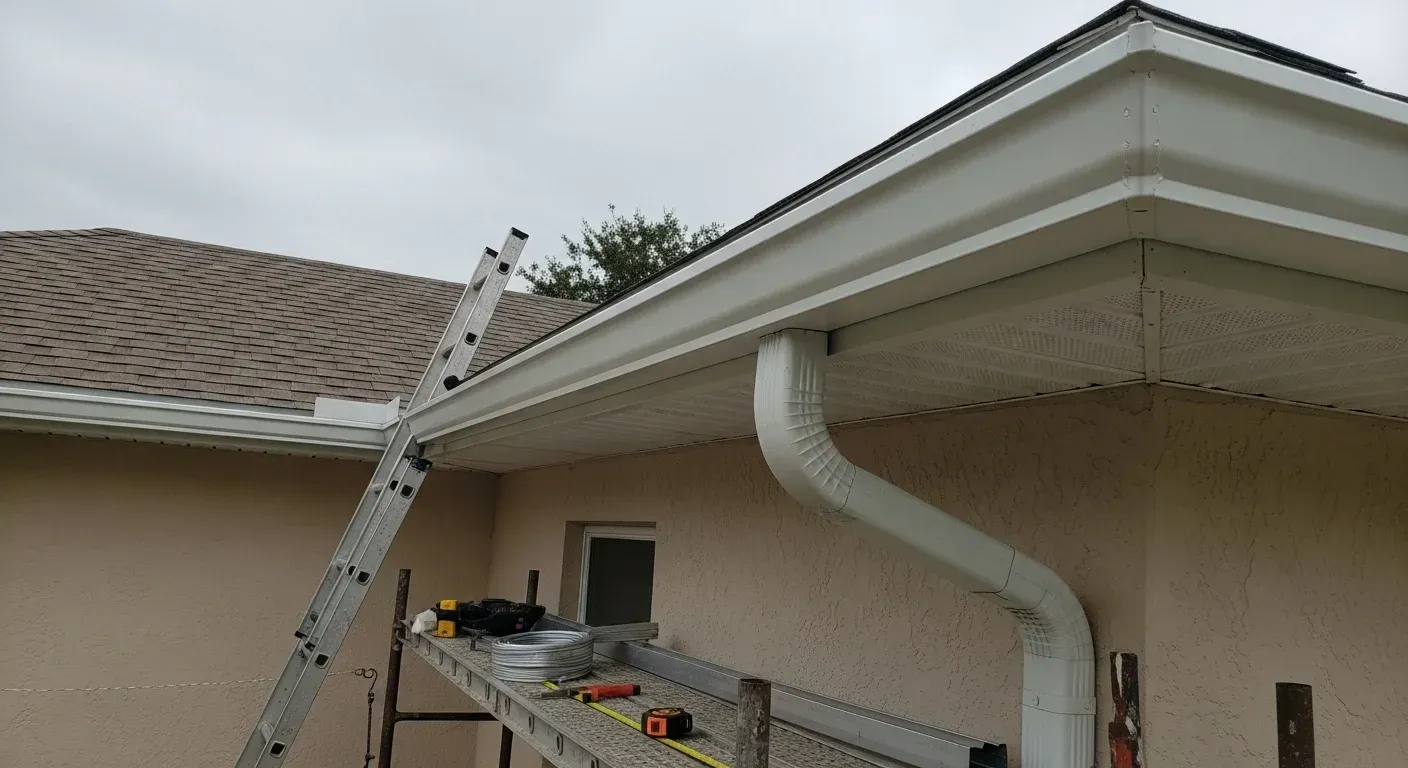
How Proper Gutter Sizing Protects the Whole Structure
Gutter sizing is not a default decision—it is a calculation based on the roof's total drainage surface and its slope angle, both of which determine how much water volume moves toward the eave in a heavy rain event. A gutter that is too narrow for the roof it serves will overflow at the back edge rather than channel water into the downspout, and that overflow lands directly against the fascia board and the structure below. Aluminum gutters are the standard material for this work because they resist corrosion, hold their profile under load, and accept standard gutter guard systems without modification.
After installation is complete, the visible change is straightforward: water leaves the roof through the downspout and discharges at a controlled point away from the structure rather than sheeting off the eave edge onto the foundation, lanai deck, or pool cage base. Properties in North Fort Myers with older wood-frame construction benefit particularly from this control because the fascia and soffit assemblies on those homes are more vulnerable to sustained moisture exposure than newer materials. Gutter guards installed as part of the system mean the gutters remain clear of the leaf and debris accumulation that causes overflow and bracket stress over time.
Repair assessments cover the full system—not just the section that has visibly failed. Loose gutters often signal that the original bracket spacing was insufficient for the gutter's load, and replacing only the damaged section without addressing bracket placement means the same failure will recur. When sections are replaced, the slope is re-verified before the job is closed out.
Common Questions About Gutter Installation and Repair
The questions below address how gutter work is actually performed, what decisions are made during installation and repair, and what to look for once the work is finished.
What determines the correct gutter size for a specific roof?
Gutter sizing is calculated from the roof's total drainage area in square feet combined with its pitch, which affects how fast water moves toward the eave; a steeper pitch increases the flow rate and typically requires a wider gutter profile to handle the volume without overflowing.
How is gutter slope set during installation?
Gutters are hung with a deliberate fall—typically around one-quarter inch of drop per ten feet of run—toward each downspout location, which is set using a level and measured drops rather than by eye, because a gutter hung flat will hold standing water and accelerate corrosion at seams and end caps.
What happens during a gutter repair assessment?
The full run of guttering is inspected for clogs, damaged or separated sections, failed sealant at joints, loose or missing brackets, and downspout connections that have pulled away from the structure, so the repair addresses the actual cause of failure rather than only the visible symptom.
Why do gutter guards matter for properties with overhanging trees?
Debris accumulation inside the gutter adds weight that stresses brackets and seams, causes overflow at the back edge nearest the fascia, and can create standing water that breeds pests; guards reduce the frequency and volume of debris entering the channel and are included with A Tip Top Rescreen installations as a standard component.
What should be checked after gutter installation is complete?
Walk the perimeter during or immediately after rain and verify that water exits only at the downspout discharge point, that no overflow occurs at the back edge or end caps, and that the downspout directs water away from the foundation, pool cage base, and any lanai slab edge.
A Tip Top Rescreen also installs and repairs gutters in Rotonda West, North Fort Myers, Cape Coral, Estero, Naples, and Bonita Springs. If your current gutters are overflowing, pulling away from the fascia, or directing water toward your foundation or lanai, arrange a free estimate to have the system evaluated and a correction plan identified.